

Your best executive just got a call from a competitor — and the offer includes a retirement package yours can’t match.
That’s the moment most companies realize they needed a Supplemental Executive Retirement Plan yesterday.
Standard 401(k)s top out at $23,500. For an executive earning $400,000, that’s pocket change. Meanwhile, the 2026 IRS Roth mandate is quietly stripping away what little pre-tax advantage high earners had left.
Knowing how to set up a Supplemental Executive Retirement Plan isn’t just a compliance exercise — it’s how smart employers win the talent war, lock in their top performers, and build a retirement strategy with zero contribution ceiling.
Key Takeaways
- A Supplemental Executive Retirement Plan (SERP) is a non-qualified, employer-funded deferred compensation arrangement designed exclusively for a select group of highly compensated or management-level employees.
- SERPs carry no IRS contribution limits, making them uniquely powerful for executives who have already maxed out their 401(k)s.
- Starting in 2026, executives earning over $145,000 are mandated under SECURE 2.0’s Section 603 to route 401(k) catch-up contributions into Roth (after-tax) accounts — making SERPs the last viable pre-tax savings stronghold for high earners.
- Proper setup requires five core steps: defining eligibility (the “Top Hat” rule), choosing a plan design, selecting a funding strategy, drafting a legally binding agreement with vesting schedules, and filing a Top Hat notice with the DOL within 120 days.
- Corporate-Owned Life Insurance (COLI) is the preferred funding vehicle for most companies due to its tax-deferred cash value growth and built-in death benefit.
- All SERPs must comply with IRC Section 409A, which governs the timing of deferrals, elections, and distributions.
Why SERPs Matter More Than Ever in 2026
For decades, the 401(k) has been the default retirement vehicle for American workers. But for executives earning $300,000, $500,000, or more per year, the standard 401(k) contribution ceiling — $23,500 in 2025, with modest annual increases — is essentially a rounding error in their retirement picture.
The math is unforgiving. An executive drawing a $400,000 salary who contributes the maximum to their 401(k) is deferring less than 6% of their income into a tax-advantaged account. Compare that with the general financial planning guidance that high earners should target replacing 70–80% of pre-retirement income — and the gap becomes a chasm.
Now layer in the 2026 Roth mandate under SECURE 2.0’s Section 603. Under this rule, employees earning more than $145,000 who are aged 50 and above can no longer make pre-tax catch-up contributions to their 401(k). Every dollar of catch-up must now flow into a Roth account — meaning taxes are due today, at top marginal rates, on money that high earners desperately need growing tax-deferred. You can read more about how this rule is catching executives off guard in our breakdown of why some 2026 retirement savers regret aggressive 401(k) contributions and early Roth conversions.
A Supplemental Executive Retirement Plan sidesteps all of these limitations. It is, in effect, the last major pre-tax savings vehicle for high earners — unlimited in contribution size, flexible in design, and entirely controlled by the employer. For business owners, HR directors, and compensation committees, understanding how to set one up correctly in 2026 is not just a nice-to-have. It is a competitive necessity.
What Exactly Is a SERP?
A SERP is a formal, contractual promise made by an employer to pay a specified retirement benefit to a designated executive at a future date — typically upon retirement, disability, death, or separation from service. It is a non-qualified deferred compensation (NQDC) arrangement, meaning it operates outside the strict ERISA rules that govern 401(k)s and pension plans.
Because it sits outside ERISA, a SERP is not subject to nondiscrimination testing, vesting minimums mandated by federal law, or IRS contribution caps. The company retains full control over who participates, how much is credited to the plan, and under what conditions benefits are paid. In exchange for this flexibility, the employer cannot take an immediate tax deduction on contributions — the deduction is only realized when the benefit is actually paid to the executive.
For a deeper overview of how these plans compare to standard qualified plans, see our foundational guide on the Supplemental Executive Retirement Plan.
Step-by-Step Guide: How to Set Up a SERP
Step 1: Define Eligibility — Understanding the “Top Hat” Rule
The very first — and most legally consequential — decision in establishing a SERP is determining who qualifies. A SERP is not a plan you can offer to your entire workforce. Under the Employee Retirement Income Security Act (ERISA), non-qualified plans like SERPs are only exempt from most ERISA requirements if they are maintained for a “select group of management or highly compensated employees.”
This exemption is commonly referred to as the Top Hat rule. The Department of Labor (DOL) has historically interpreted “select group” to mean a small percentage of the overall workforce — not a broad swath of mid-level managers. Courts and DOL guidance have indicated that while there is no rigid percentage cutoff, plans covering more than 10–15% of employees risk losing Top Hat status, which would trigger full ERISA compliance obligations and blow up the plan’s legal foundation.
Practical eligibility criteria typically include:
- Title and organizational level (C-suite, VP-level, or above)
- Base compensation threshold (commonly $200,000 or more)
- Role criticality to business performance
- Status as a Highly Compensated Employee (HCE) under IRS definitions ($160,000+ for 2026)
Document your eligibility rationale carefully. If the IRS or DOL ever scrutinizes the plan, you want a clear, defensible record of why each participant was included.
Step 2: Choose the Right Plan Design
Once you have identified your eligible executives, you must decide what the plan is actually going to promise. There are two primary SERP architectures:
Defined Benefit SERP
A defined benefit SERP works like a traditional pension. The employer commits to paying the executive a specific monthly income during retirement — for example, 50% of final average compensation — regardless of how the underlying funding performs. This approach is highly valued by executives because the benefit is predictable and guaranteed by the employer.
The downside for employers: the financial liability is real and open-ended. If investment returns on funding vehicles underperform, the company must still make up the difference.
Defined Contribution SERP
A defined contribution SERP functions more like a company-funded savings account. The employer commits to contributing a fixed dollar amount or percentage of salary into a hypothetical account each year. The benefit paid at retirement is whatever that account has accumulated to.
This approach transfers investment risk to the executive and is generally easier for the company to budget. It is the more common structure among mid-market companies and is increasingly preferred as interest rates and market volatility make defined benefit promises harder to hedge.
Many companies also explore hybrid designs — for example, a defined contribution structure with a guaranteed minimum floor, combining cost predictability with executive security.
Step 3: Make Your Funding Decision
A SERP is, technically, an unsecured promise. The IRS requires that the plan assets remain the property of the employer and subject to the claims of general creditors — this is what makes SERPs “non-qualified.” However, most companies informally fund their SERPs to ensure they can actually meet the future obligation.
Option A: Pay-as-You-Go (Unfunded)
The company makes no dedicated financial commitment today. When benefits are due, they are paid directly from operating cash flow. This approach requires no upfront investment but carries significant liquidity risk — particularly if multiple executives retire simultaneously.
Option B: Corporate-Owned Life Insurance (COLI)
This is the most widely used informal funding strategy for SERPs, and for good reason. Under a COLI arrangement, the company purchases a permanent life insurance policy on the executive’s life. The company is both the owner and the beneficiary of the policy.
How COLI works as a SERP funding vehicle:
- Premiums are paid by the company from corporate cash flow.
- The cash value of the policy grows tax-deferred inside the insurance contract — effectively matching the tax treatment of the SERP liability it is funding.
- When the executive retires and the SERP benefit is due, the company can access the policy’s cash value (through policy loans or withdrawals) to fund the payments.
- When the executive eventually passes away, the company receives a tax-free death benefit, helping to recover the cost of the benefit and the premiums paid over time.
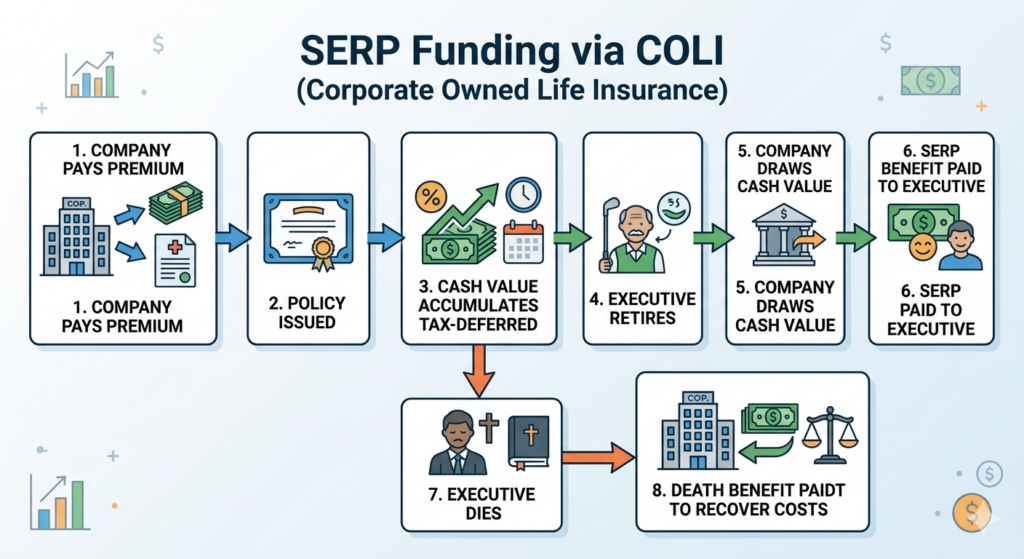
COLI is particularly attractive because it turns a pure liability (the SERP obligation) into a balance-sheet asset (the policy’s cash surrender value). For HR directors presenting this to boards, that reframing is often what moves a SERP proposal from “interesting idea” to “approved.”
To understand how life insurance intersects with broader employee benefits strategy, review our comprehensive guide on employee benefits programs for US employers.
Step 4: Draft the Plan Agreement — Include Vesting Schedules (Golden Handcuffs)
The plan agreement (sometimes called the SERP agreement or deferred compensation agreement) is the legal backbone of the entire arrangement. It must be drafted by qualified ERISA and tax counsel and must address, at minimum:
- Benefit formula: How the benefit amount is calculated.
- Vesting schedule: When the executive earns the right to the benefit.
- Trigger events: The specific events that cause a benefit to be payable (retirement, disability, death, separation from service, change of control).
- Payment timing and form: Lump sum vs. installments; single life vs. joint-and-survivor annuity.
- Forfeiture conditions: Circumstances under which the benefit is forfeited (e.g., termination for cause, competition).
The vesting schedule is where the “Golden Handcuffs” come in — and it is one of the primary reasons companies implement SERPs in the first place. A typical cliff vesting structure might provide 0% vesting for years one through four, then 100% on the fifth anniversary of the plan. A graded schedule might vest 20% per year over five years.
The message to the executive is clear: walk away before the vesting date and you leave the benefit behind. This makes the SERP an extraordinarily powerful retention tool, particularly for companies competing for senior talent in tight labor markets.
For a broader view of how vesting and compensation design fits into a total rewards strategy, see our guide on how to set up a 401(k) for your small business, which covers foundational plan design principles applicable across plan types.
Step 5: Comply with Section 409A and File Your DOL Top Hat Notice
This step is non-negotiable, and errors here carry severe consequences.
IRC Section 409A Compliance
Section 409A of the Internal Revenue Code is the governing law for all non-qualified deferred compensation arrangements, including SERPs. Enacted in 2004 in the aftermath of the Enron scandal, 409A imposes strict rules on:
- When elections to defer compensation must be made (generally before the year in which the compensation is earned).
- When distributions may occur (only upon one of six permissible trigger events: separation from service, disability, death, change of control, fixed time/schedule, or unforeseeable emergency).
- The six-month delay rule: Specified employees (generally the top 50 highly compensated employees of a publicly traded company) must wait at least six months after separation from service before receiving any distribution.
A Section 409A violation is catastrophic: the executive immediately owes income taxes on all deferred amounts, plus a 20% excise tax, plus interest. The IRS does not offer much sympathy for administrative errors. Every plan document must be drafted and operated in strict conformity with 409A — not just at inception, but every year the plan is in effect. For authoritative guidance, refer directly to IRS.gov’s Section 409A resources.
DOL Top Hat Filing
Within 120 days of the plan becoming effective, the employer must file a brief statement with the U.S. Department of Labor (DOL) indicating that the company maintains a Top Hat plan. This is a simple, one-page notice submitted electronically through the DOL’s EFAST2 system at DOL.gov. Failure to file does not void the plan but eliminates your ERISA exemption for certain enforcement provisions.
401(k) vs. SERP: The Decision-Making Comparison
| Feature | 401(k) Plan | SERP (Non-Qualified) |
|---|---|---|
| Contribution Limit | $23,500 (2025); $31,000 with catch-up | Unlimited |
| Tax Status | Qualified (ERISA-governed) | Non-Qualified (ERISA-exempt) |
| Nondiscrimination Testing | Required (ADP/ACP tests) | Not required |
| Participant Selection | Must be offered to all eligible employees | Can be limited to specific executives |
| Asset Security | Protected from employer creditors (ERISA § 404) | Subject to employer’s general creditors |
| Tax Deduction for Employer | Immediate upon contribution | Only when benefits are paid |
| 2026 Catch-Up Treatment | Roth-only for earners >$145k | N/A — no catch-up limit applies |
| SECURE 2.0 Impact | Significant — Roth mandate for HCEs | Minimal — continues as pre-tax vehicle |
| Funding Vehicle | Employee/employer contributions to trust | COLI, cash reserves, or unfunded |
| DOL Filing Required? | Form 5500 (annual) | Top Hat notice only (one-time) |
As this table makes clear, the 401(k) and the SERP are not competing instruments — they are complementary. Most well-designed executive compensation packages include both: the 401(k) for its broad accessibility and ERISA protections, and the SERP for its unlimited ceiling and pre-tax advantage. If you are structuring the qualified plan layer for a smaller organization, our guides on small business 401(k) plans and 401(k) plans for 5–10 employees offer excellent foundational context.
Step-by-Step SERP Implementation Checklist
Use this checklist to track your progress from concept to compliant plan:
Phase 1: Planning & Design
- [ ] Identify eligible executive participants (apply Top Hat test)
- [ ] Engage ERISA counsel and an executive compensation consultant
- [ ] Select plan type: Defined Benefit or Defined Contribution
- [ ] Determine benefit formula and projected liability
- [ ] Conduct executive demographic review (age, tenure, compensation)
Phase 2: Funding Strategy
- [ ] Model COLI vs. pay-as-you-go funding scenarios
- [ ] If using COLI: conduct executive health underwriting
- [ ] Obtain board or committee approval for funding commitment
- [ ] Establish internal accounting for plan liability (for balance sheet)
Phase 3: Legal Documentation
- [ ] Draft SERP plan document (must comply with IRC § 409A)
- [ ] Define permissible payment triggers and distribution elections
- [ ] Incorporate vesting schedule and forfeiture provisions
- [ ] Include non-compete/non-solicitation conditions if applicable
- [ ] Obtain legal review and board ratification
Phase 4: Compliance Filing
- [ ] File Top Hat statement with DOL within 120 days of plan effective date
- [ ] Establish annual 409A compliance review process
- [ ] Brief payroll and finance teams on W-2 reporting (FICA timing)
Phase 5: Ongoing Administration
- [ ] Review plan annually for regulatory changes
- [ ] Update benefit statements for participants
- [ ] Reassess COLI policy performance against plan liability annually
- [ ] Coordinate with chartered retirement planning advisors for executive financial planning integration (see: Chartered Retirement Planning Counselor credentials)
The 2026 Tax Landscape: Why Now Is the Right Time
The SECURE 2.0 Act’s Roth catch-up mandate — effective January 1, 2026 — fundamentally changes the calculus for high-earning executives. For an executive in the 37% federal bracket earning $400,000, being forced to route $7,500 in catch-up contributions into a Roth account costs roughly $2,775 in additional federal taxes this year versus the pre-2026 treatment.
A well-designed SERP eliminates this problem entirely. Employer contributions to a SERP are not subject to the Roth mandate. They accumulate without a contribution ceiling. And the executive pays income taxes only when distributions are received — presumably in retirement, when marginal rates may be lower.
This is not a minor planning nuance. For companies competing for executives in the $200,000–$1,000,000+ compensation range, the ability to offer a SERP in 2026 is a meaningful differentiator in recruiting conversations. Combine it with a comprehensive employee benefits program and a strong qualified plan foundation, and you have a total rewards package that can retain executives for the long haul.
For executives who are already close to retirement and looking to maximize their final accumulation years, our guide on how to maximize your retirement covers additional strategies that dovetail with SERP income planning.
Key Risks to Understand
SERPs are powerful — but they carry risks that both employers and executives must understand before signing.
For the Executive:
- Unsecured promise: Unlike a 401(k) held in a protected trust, SERP benefits are an unsecured contractual obligation. If the company declares bankruptcy, the executive stands in line with general creditors. This is not hypothetical — Enron executives famously lost NQDC balances worth tens of millions of dollars.
- Forfeiture risk: Miss a vesting milestone due to termination — even involuntary — and the benefit may be forfeited.
- Tax concentration risk: All SERP distributions are taxed as W-2 income in the year received, potentially pushing the executive into the highest marginal bracket.
For the Employer:
- Accounting liability: The plan obligation must be carried on the balance sheet. For large benefit promises, this affects financial ratios.
- COLI mortality risk: If an executive leaves the company, the COLI policy may be less cost-effective, depending on policy terms.
These risks reinforce why integrating a SERP into a comprehensive financial planning strategy — for both the company and the executive — is essential.
Frequently Asked Questions
Q: Is a SERP contribution tax-deductible for the employer?
Not immediately. The employer receives a tax deduction only when the benefit is actually paid to the executive — not when contributions are made or COLI premiums are paid. This is a fundamental difference from qualified plans like 401(k)s, where employer contributions are deductible in the year made.
Q: Does a SERP require IRS approval?
No. Unlike qualified plans, SERPs do not require a determination letter or approval from the IRS. However, the plan document must be drafted in full compliance with Section 409A, and any operational failure must be corrected using the IRS’s correction programs.
Q: Can a SERP be offered to just one executive?
Yes. A SERP is a bilateral agreement between the employer and the executive. A company can implement a single-participant SERP for a sole CEO, CFO, or other key individual without offering it to anyone else.
Q: What happens to a SERP upon a change of control (acquisition)?
This depends entirely on the plan document. Many SERP agreements include “change of control” provisions that accelerate vesting or trigger immediate payment — or conversely, that require the acquiring company to assume the obligation. These provisions must be drafted carefully under Section 409A, which restricts the timing and form of accelerated payments following a change of control.
Q: Can a nonprofit organization use a SERP?
Yes, but with important modifications. Tax-exempt organizations (501(c)(3)s) typically use 457(b) or 457(f) plans as their primary supplemental executive retirement vehicle, as these are specifically designed for non-profit employers. IRC § 4960 imposes an excise tax on excessive executive compensation at tax-exempt entities, so plan design requires additional care.
Q: How does a SERP appear on the executive’s W-2?
SERP contributions made by the employer are generally subject to FICA taxes in the year they vest (not when paid). This means the Social Security and Medicare taxes are paid upfront when the benefit vests. Income taxes, however, are deferred until the benefit is actually distributed. Proper coordination between the plan administrator and payroll is essential — see our Payroll Benefits Administrator Guide for more on managing these obligations.
Final Thoughts: SERPs as a Strategic Asset in 2026
A Supplemental Executive Retirement Plan is not just a retirement benefit. It is a strategic instrument — one that simultaneously addresses talent retention, pre-tax wealth accumulation, and the increasingly restrictive landscape of qualified plan limits. In 2026, with the Roth catch-up mandate removing a key tax advantage from 401(k)s for high earners, the SERP has moved from “premium add-on” to “essential component” of any serious executive compensation strategy.
The setup process is not simple. It requires legal expertise, actuarial analysis (for defined benefit designs), careful compliance with Section 409A, and thoughtful integration with the executive’s broader financial picture. But for organizations that get it right, the result is a compensation package that no competitor can easily replicate — one that makes your best executives genuinely expensive to poach.
Start with a qualified ERISA attorney, an executive compensation consultant, and a thorough read of your existing 401(k) structure. Then build from there.
For executives interested in how a SERP fits into their complete retirement income picture — alongside Social Security, qualified plan assets, and personal investments — our resource on retirement benefits and Social Security provides essential context for the planning conversation.
This article is for informational purposes only and does not constitute legal, tax, or financial advice. Please consult a qualified ERISA attorney, CPA, or CFP® before implementing a Supplemental Executive Retirement Plan. External regulatory references: IRS Section 409A guidance | DOL Top Hat Plan Filing

Karthick Raja, MBA, is a personal finance educator and HR professional with 10+ years of experience in Personal Finance ,taxation, payroll, and career development. He helps readers build wealth, manage money wisely, and grow professionally.